The Great Seal of the State of Missouri — Brand Overview
The Great Seal of the State of Missouri is one of the most historic and meaningful symbols of the state’s identity, authority, and heritage. It isn’t just a decorative emblem — it’s a visual narrative representing Missouri’s journey into statehood, its values, principles, and its relationship with the United States. The seal appears on official documents, government buildings, the Missouri state flag, and more, embodying both civic pride and legal authenticity.
Officially adopted on January 11, 1822, the seal was designed to reflect the state’s aspirations, strength, unity, and commitment to the people.
Logo History
The seal’s creation came shortly after Missouri entered the Union. Tasked with crafting a symbol worthy of representing the new state, Judge Robert William Wells designed the emblem with deep symbolic intent — blending elements of the state’s heritage with national ideals.
Though minor stylistic variations have appeared over the centuries, the core composition of the seal has remained the same since the early 19th century. It continues to serve both ceremonial and official purposes, authenticating documents issued by the state government.
Design Meaning & Symbolism
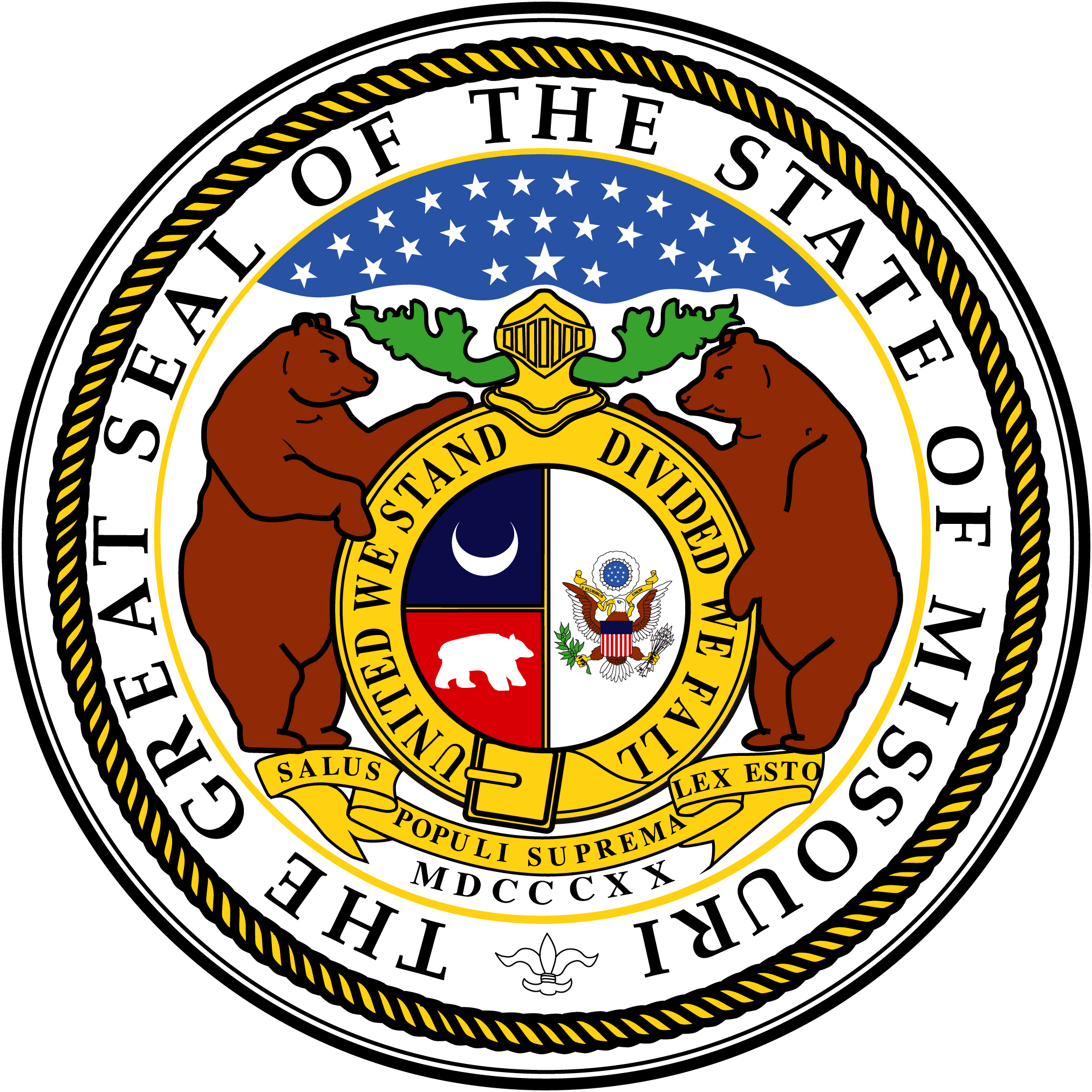
Every element of the Great Seal of Missouri has specific meaning, drawn from history, heraldry, and civic values:
Central Shield
The heart of the seal features a shield divided into two distinct parts:
- On the right, the Great Seal of the United States — with its bald eagle clutching arrows and olive branches — emphasizes Missouri’s place within the Union and its loyalty to the federal government.
- On the left, state symbols — including a grizzly bear and a silver crescent moon — represent Missouri’s strength and early promise for growth.
Crescent Moon
The crescent moon is rich in layered meaning:
- In heraldry, it symbolizes new beginnings and potential — fitting for Missouri as a young state with much to grow toward.
- It also represents Missouri being the “second son,” since it was the second state formed out of the Louisiana Territory.
Grizzly Bears
Two grizzly bears flank the shield, which symbolize the strength, courage, and resolve of the people of Missouri. Although grizzlies didn’t historically populate the region, this heraldic choice emphasizes powerful virtues.
“United We Stand, Divided We Fall”
Encircling the shield is a belt bearing the phrase “United we stand, divided we fall.” This phrase promotes unity — both within Missouri and with the broader United States — as essential for success and harmony.
State Motto
Beneath the bears is a scroll inscribed with Missouri’s Latin motto:
“Salus populi suprema lex esto.”
This phrase translates to “Let the welfare of the people be the supreme law” — a principle rooted in governance that places the good of the citizens above all else.
Roman Numerals & Stars
Below the motto are Roman numerals for 1820, the year Missouri began functioning as a state. Above the shield, a cluster of 24 stars — one large surrounded by 23 smaller ones — signifies Missouri’s status as the 24th state admitted to the Union. The surrounding cloud symbolizes the challenges the state faced in achieving statehood.
Helmet
The helmet above the shield denotes sovereignty and self‑governance, affirming Missouri’s authority over its own internal affairs.
Color Philosophy
Although the Great Seal is often depicted monochromatically in formal use, its full‑color renderings — especially on the state flag — incorporate meaningful hues:
- Blue represents vigilance, justice, and perseverance.
- Red conveys courage and valor.
- White stands for purity and innocence.
These colors echo not just Missouri’s identity, but also align with the national palette of the United States, tying state and nation together visually and symbolically.
Cultural & Civic Significance
The Great Seal of the State of Missouri goes beyond formal authentication — it’s a living symbol used in public ceremonies, government publications, and places of authority. Its presence reinforces civic responsibility, state pride, and a shared historical narrative that unites Missourians today with those who shaped the state nearly 200 years ago.
Because it is featured on the state flag and many official artifacts, the seal is one of the most instantly recognizable visual representations of Missouri anywhere it appears.
Frequently Asked Questions (FAQs)
Q1: When was the Great Seal of Missouri adopted?
It was adopted by the Missouri General Assembly on January 11, 1822.
Q2: What does the state motto mean?
“Salus populi suprema lex esto” means “Let the welfare of the people be the supreme law,” emphasizing that governance should prioritize the wellbeing of citizens.
Q3: Why is there a crescent moon on the seal?
In heraldry, the crescent represents new beginnings and growth. It also signifies Missouri’s early promise and status as the second state formed from the Louisiana Territory.
Q4: What do the bears represent?
The bears symbolize strength and bravery, reflecting the character and resilience of Missouri’s people.
Q5: Why are there 24 stars?
The large star surrounded by 23 smaller ones represents Missouri’s position as the 24th state admitted to the U.S. Union.